Vendor-Neutral Advisory

In brief: CMMC, HIPAA, FFIEC and NCUA exams, and PCI DSS 4.0 all come with a date, whether it's an assessment, an exam, an audit or a contract milestone. The problem usually isn't knowing what the framework requires. It's runway: closing gaps takes weeks, and most teams find out too late that they need more weeks than they have left. This guide explains how to measure your compliance runway, where each of the four frameworks stands in October 2026, the three questions almost every auditor asks, and how to check your own runway in about eight minutes with MALA's free Compliance Gap Check.
October is Cybersecurity Awareness Month, and this year's message is a blunt one: don't make it easy for them. Last week we looked at the risks you can't see. This week is about a risk everyone can see coming, and still gets caught by: the assessment date.
Every framework has one. A bank exam is on the calendar. A health system customer wants your HIPAA evidence before renewal. A prime contractor needs your SPRS score before it extends a subcontract. Your acquirer wants a PCI report on compliance. The date rarely moves in your favor, and it doesn't care how busy the quarter was.
Compliance runway is the time between today and your next assessment, compared with the time it will realistically take to close your open gaps. If closing the gaps takes less time than you have, you have runway. If it takes more, you are already late, even if the assessment is months away.
The math is simple. Two adjustments make it honest:
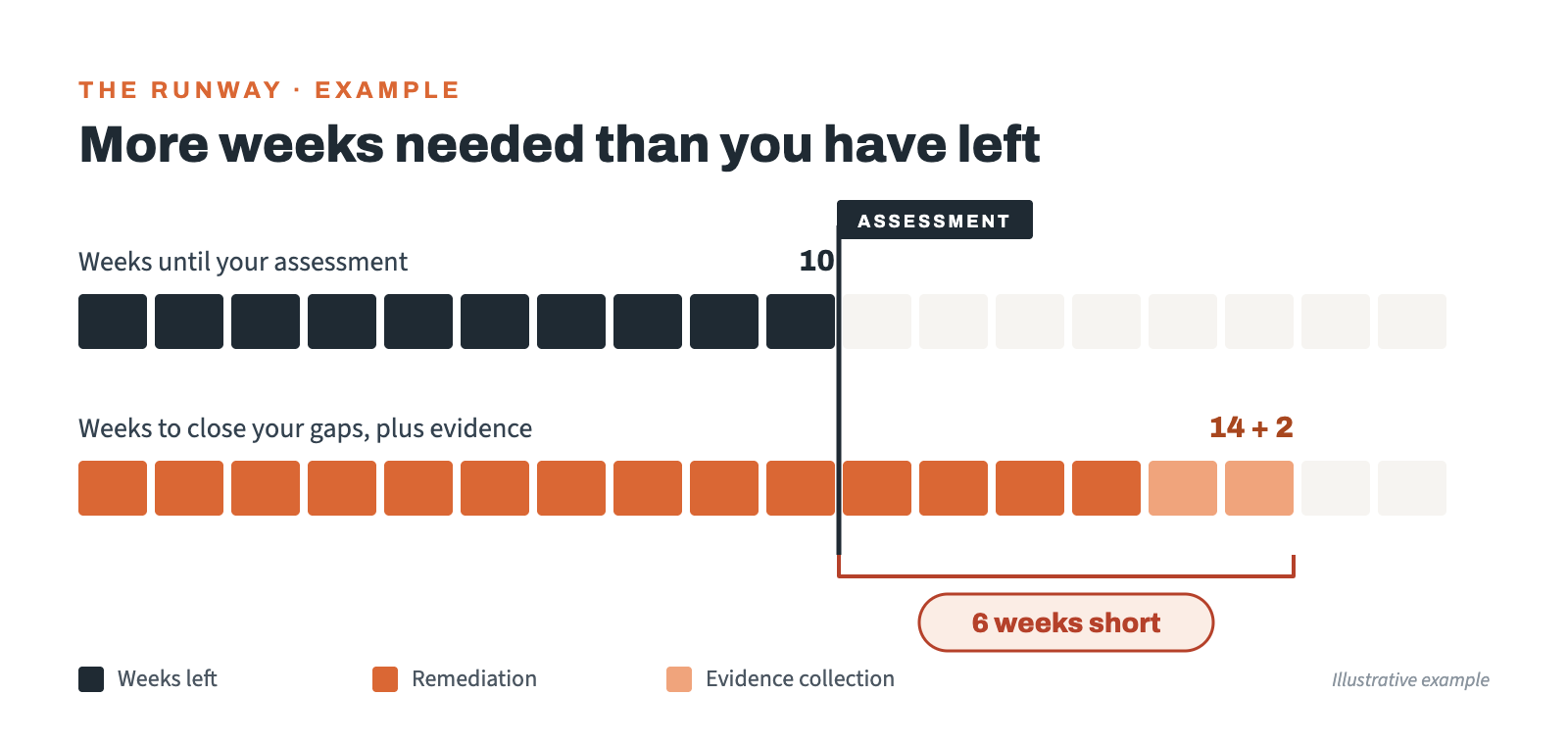
Run the numbers and many teams discover the same thing: the assessment is ten weeks out, but closing the gaps takes fourteen, plus two for evidence. That is a six-week shortfall, and it was visible on day one to anyone who did the arithmetic.
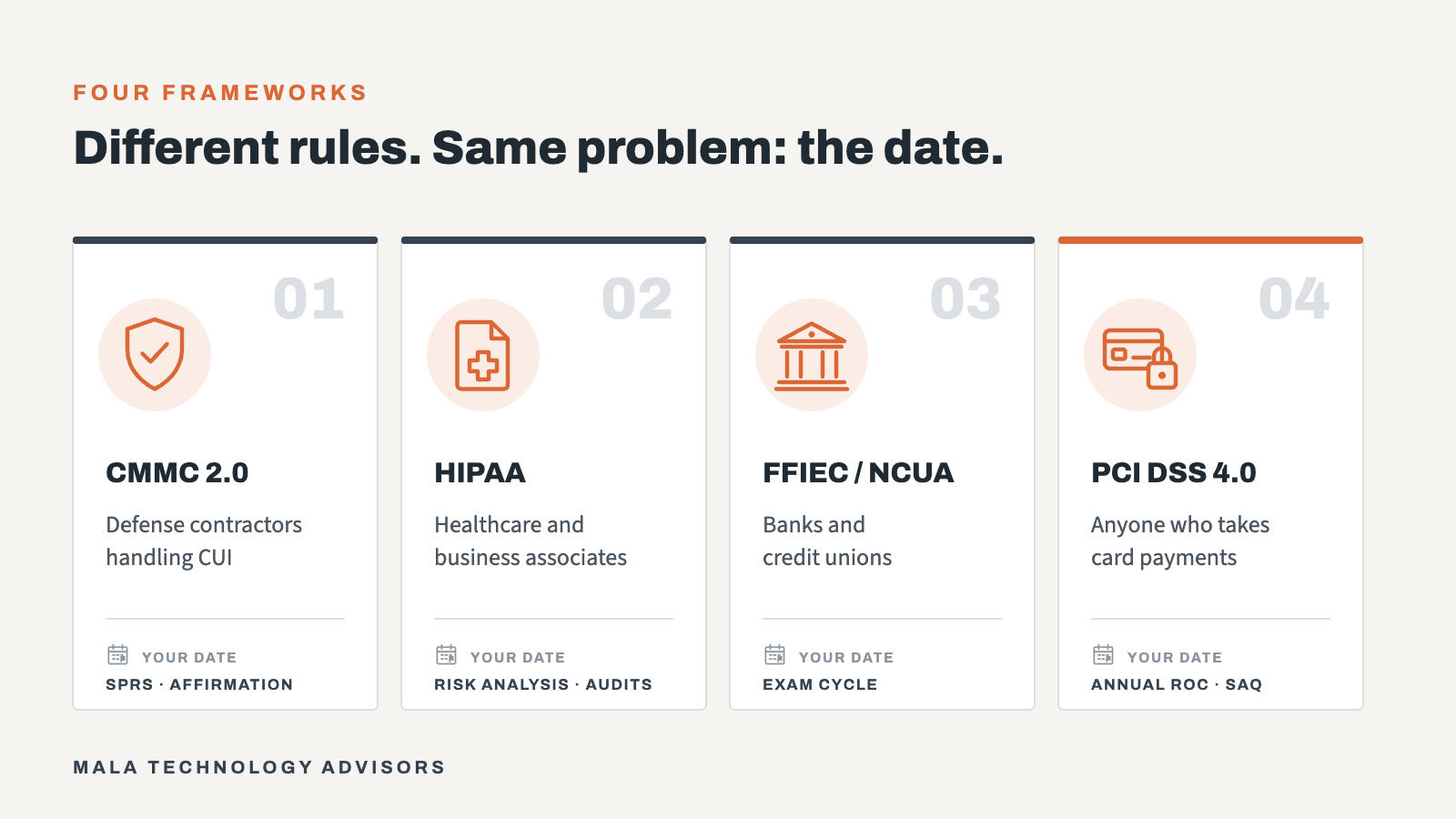
The four frameworks below have different rules and different dates. Runway is the problem they share.
CMMC has had a turbulent year. Phase 1 began on November 10, 2025, requiring Level 1 and Level 2 self-assessments in applicable contracts. Phase 2, which would have made third-party (C3PAO) certification the default for contracts involving controlled unclassified information from November 10, 2026, was suspended by the Department of Defense on July 13, 2026, pending a review of the program. As of this writing, it remains on hold.
It's tempting to read that as a reprieve. It isn't much of one. The suspension covers the third-party assessment requirement, not the underlying obligations. Contractors handling CUI still need to implement the 110 controls in NIST SP 800-171, keep an accurate score in SPRS, submit annual affirmations of compliance and meet DFARS 7012 incident-reporting rules. Many primes are still asking suppliers for proof, and the Justice Department continues to pursue False Claims Act cases over misrepresented security. If a third-party requirement returns, the contractors who kept going will be the ones with runway.
The question to ask: If a prime or an assessor asked tomorrow, could we show all 110 controls working, with evidence, and does our SPRS score reflect that?

HIPAA doesn't hand you a single assessment date. Your dates come from elsewhere: an OCR investigation after a breach, a health system that audits its vendors before renewal, a cyber insurance application, or your own annual risk analysis. Because no one sets the date for you, it's easy to let the work drift until someone else does.
The rules are also getting more specific. HHS proposed the first major update to the HIPAA Security Rule in years, with explicit expectations for encryption, multifactor authentication, network segmentation, written and tested incident response plans, and more prescriptive risk analysis. The final rule is now listed for July 2027. Organizations that wait for the final text will be starting their remediation with the clock already running.
The question to ask: Is our risk analysis less than a year old, and could we show who accessed patient data last month?

Financial institutions have the most predictable dates of the four: the exam cycle. That predictability can be a trap, because the next exam always feels far away until the request letter arrives, and the list of items to produce is long.
The tools have shifted, too. The FFIEC retired its Cybersecurity Assessment Tool on August 31, 2025, and pointed institutions toward resources such as the NIST Cybersecurity Framework 2.0 and CISA's Cybersecurity Performance Goals. The NCUA kept its Automated Cybersecurity Evaluation Toolbox (ACET) available for credit unions and said it would align ACET with those same resources. Either way, examiners still expect you to show that controls exist, that they work, and that you understand the third parties your operations depend on.
For the vendor side of that list, see our practical framework for third-party risk management.
The question to ask: If the exam request letter arrived today, which items would take us more than two weeks to produce?
PCI DSS has a fixed annual rhythm: a report on compliance or a self-assessment questionnaire, plus quarterly scans. The newest pressure comes from version 4.0. Its 51 "future-dated" requirements, which organizations could treat as best practice for the first year, became fully applicable in assessments after March 31, 2025. For many merchants, this year's assessment is the first where all of them count.
Several of those requirements take real lead time, because they depend on new tooling or on providers: managing and monitoring the scripts that run on payment pages, detecting unauthorized changes to those pages, stronger authentication into the cardholder data environment, and documented targeted risk analyses that justify how often you perform certain controls.
The question to ask: Are the requirements that became mandatory in March 2025 actually in place, or only on the roadmap?
The frameworks differ, but a handful of questions come up in nearly every assessment, exam and audit. If you can't answer these three with a confident yes and evidence to back it, start here:
None of the three requires a new platform. All three take longer than people expect, because they depend on change windows, provider tickets and other teams' calendars. That's exactly why they belong at the front of the runway.
Gaps are rarely a surprise. Running out of time usually is. The causes are consistent:
You don't need to solve everything this month. You need to know where you stand and start the longest work first:
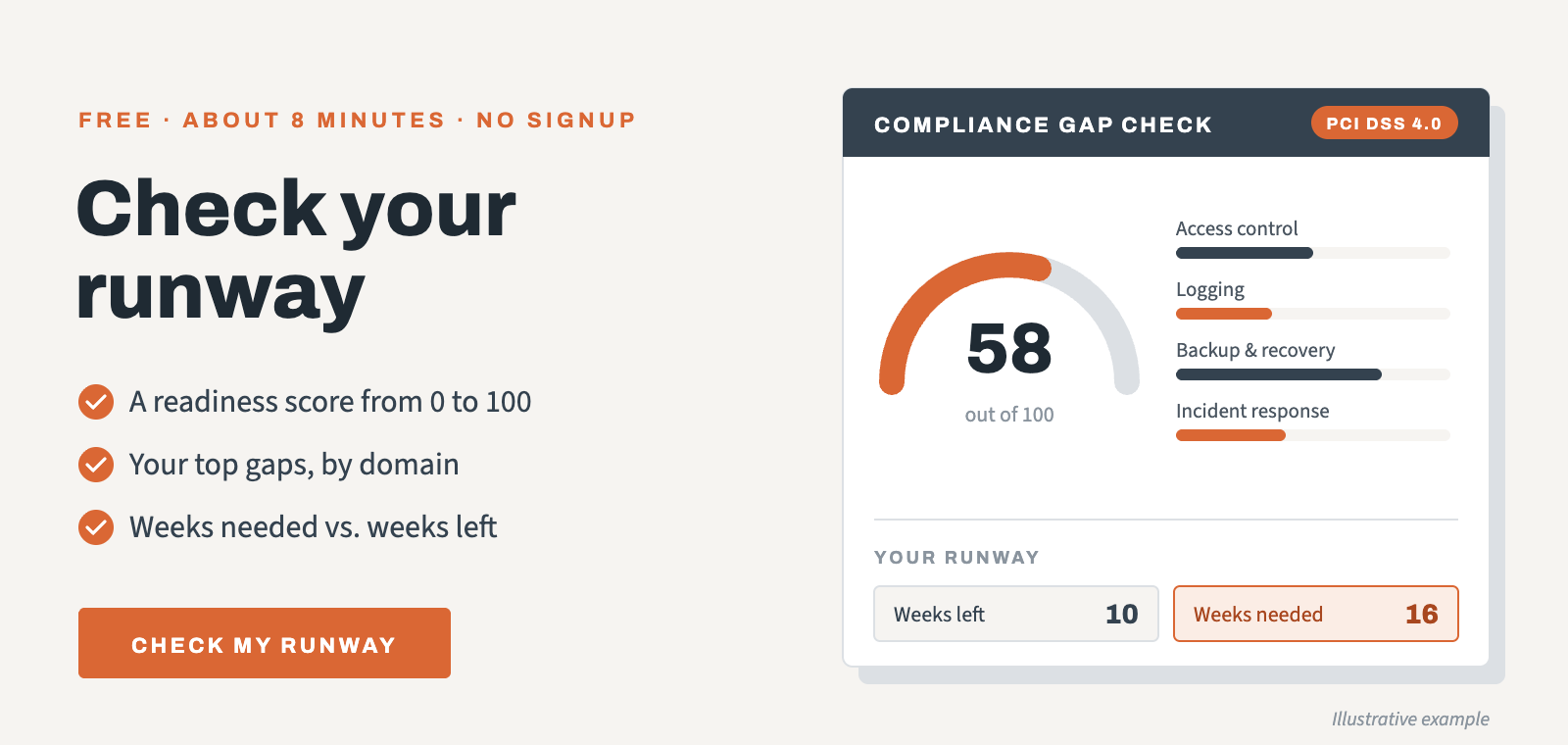
MALA's free Compliance Gap Check does the runway math for you. Pick CMMC 2.0, HIPAA, FFIEC/NCUA or PCI DSS 4.0, answer 20 control questions, and enter your assessment date. You'll see a readiness score from 0 to 100, how many gaps are open, your top three, a breakdown by domain, and how the weeks needed to close your gaps compare with the weeks you have left.
It takes about eight minutes, and your results appear on screen with no signup. If you want the full remediation plan, with every gap ranked by risk and a week-by-week timeline sequenced to your assessment date, you can request it, and a MALA advisor can match each gap to providers who know your framework. It's a directional self-assessment, not a formal audit, and it's vendor-neutral: MALA is paid by providers, not by you.
A compliance gap assessment compares the controls a framework requires with the controls you actually have in place, and lists the differences. A useful one also estimates how long each gap takes to close, so you can compare that with your assessment date.
The suspension pauses the requirement for mandatory third-party certification. Contractors handling CUI still need to implement NIST SP 800-171, maintain an accurate SPRS score, submit annual affirmations and complete Level 1 or Level 2 self-assessments where contracts require them. Check your contract language and prime flow-downs in writing, and confirm specifics with your contracting officer or counsel.
The FFIEC retired the tool on August 31, 2025, and pointed institutions to resources such as the NIST Cybersecurity Framework 2.0 and CISA's Cybersecurity Performance Goals. Credit unions can continue to use the NCUA's ACET, which the NCUA is aligning with those resources.
The 51 future-dated requirements introduced in version 4.0 became fully applicable in assessments after March 31, 2025. They include payment page script management and change detection, stronger authentication into the cardholder data environment, and targeted risk analyses.
Yes. It takes about eight minutes, needs no signup to see your results, and is a directional self-assessment rather than a formal audit or legal opinion.
Cybersecurity Awareness Month · Video 3 of 4
Don't make it easy for them.
Oct 5: Payment fraud and deepfakes · Oct 12: Blind spots · Oct 19: Compliance deadlines · Oct 26: Cyber insurance renewal
About the author: Eric Anderson is the Founder and President of MALA Technology Advisors. After two decades working with organizations ranging from early-stage startups to Fortune 500 enterprises, he saw the same pattern repeat: significant technology decisions being made without independent, vendor-neutral expertise at the table. He founded MALA to close that gap, and now leads its advisory practice across cybersecurity, cloud, AI infrastructure, and technology procurement.
