
Vendor-Neutral Advisory

In brief: Some of the most expensive technology risks stay invisible until something breaks. Four show up again and again in incident reviews: shadow AI, AI agents with too much access, provider outages nobody explains, and network warning signs nobody connects. None looks urgent on its own, which is exactly why they persist. This guide explains each blind spot, how to tell whether you have it, what to fix first, and how to score all four in about five minutes with MALA's free Blind Spots Scorecard.
October is Cybersecurity Awareness Month, and this year's message is a blunt one: don't make it easy for them. Last week we looked at how a cloned voice can move your money. This week is about a quieter problem: the risks you can't see.
Most security gaps don't announce themselves. Nobody files a ticket that says "we have a blind spot." The gap shows up afterward, in the incident review, when someone asks how long a problem had been there and the honest answer is "longer than we knew." A wire is gone. An audit fails. A cyber insurance policy won't renew on the same terms. Looking back, the warning signs were there. They just weren't anyone's job.
Watch: the 4 blind spots in 60 seconds
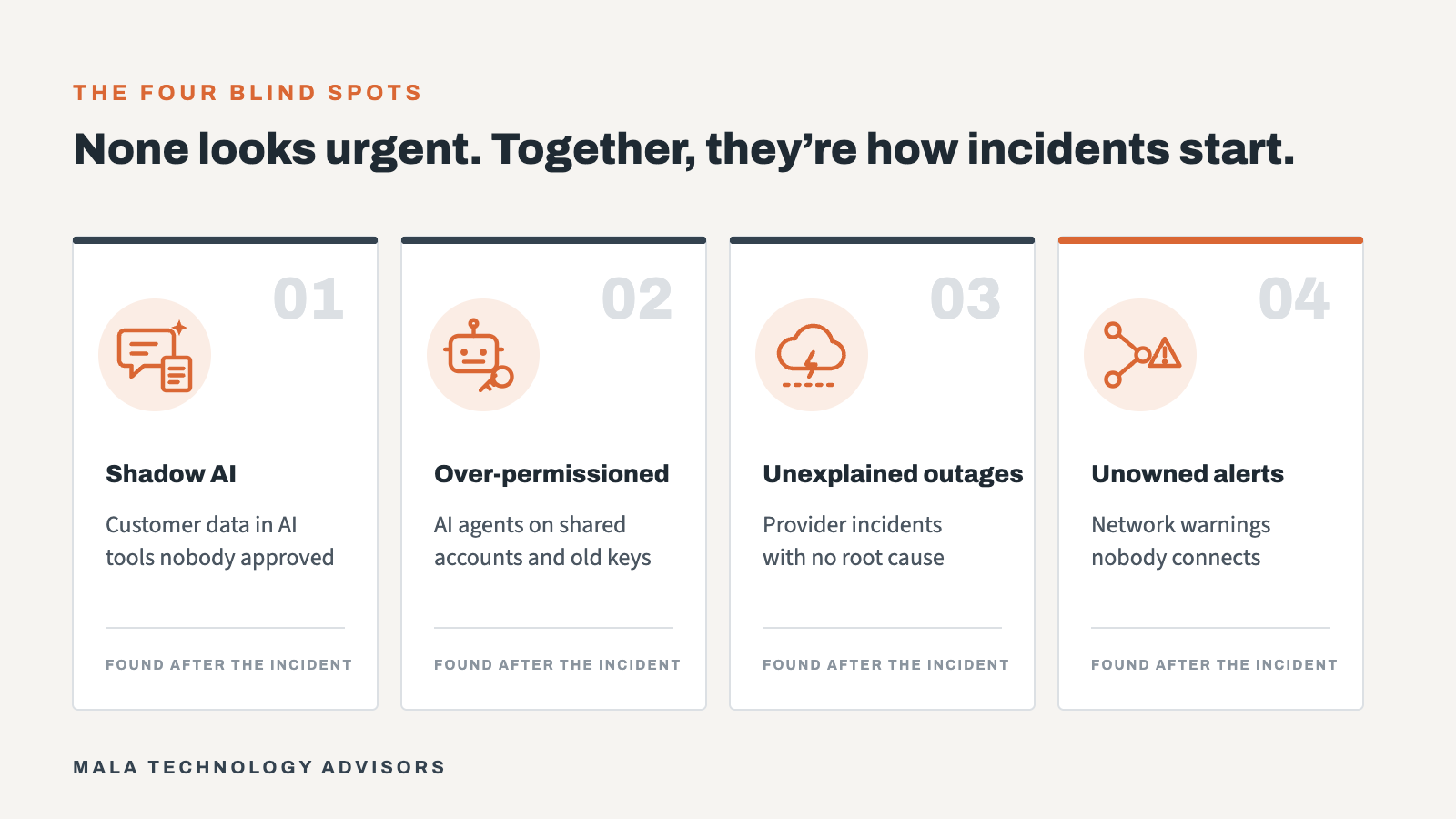
A cybersecurity blind spot is a risk your organization carries but can't currently see, measure or assign to an owner. It isn't the same as a known risk you've chosen to accept. A known risk sits on a register with a name next to it. A blind spot sits between teams, outside the reports anyone reads, until an incident drags it into view.
For mid-market organizations, and especially for banks, credit unions, healthcare practices and government contractors, blind spots tend to grow in the same four places. Two are new, driven by how fast AI has moved into everyday work. Two are old problems made worse by how much of IT now runs through outside providers.
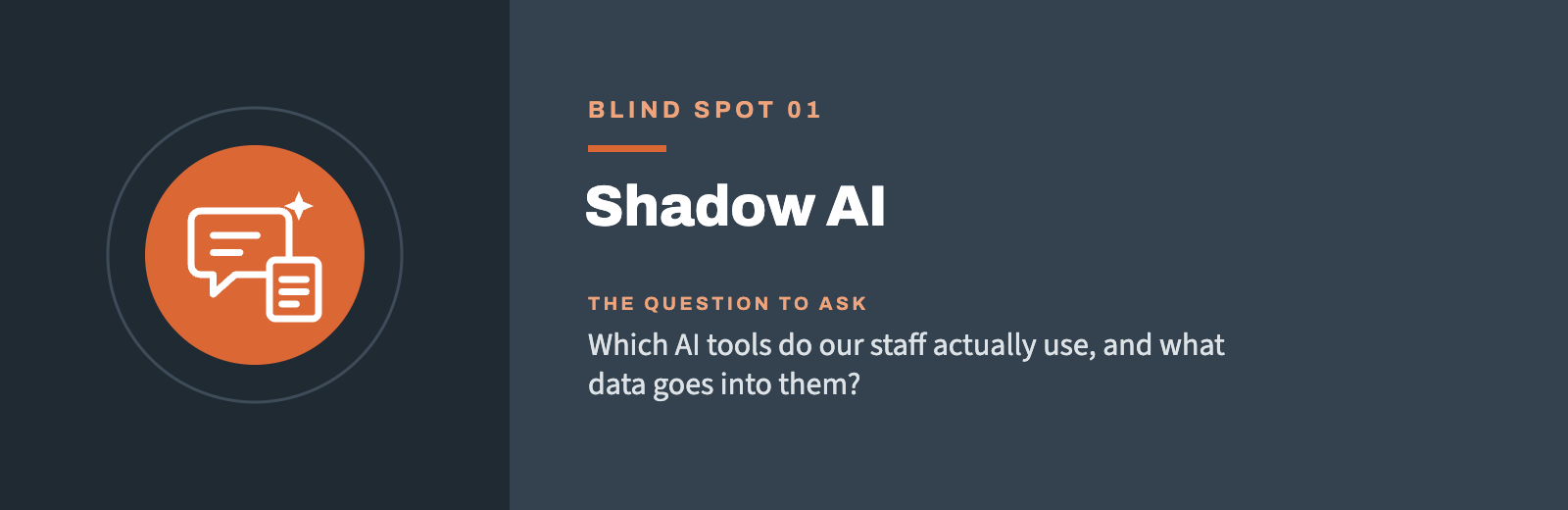
Somewhere in your organization, someone has pasted a customer list, a contract or a spreadsheet of account data into a free AI tool. They weren't being careless. They were trying to finish work faster, and the tool was right there in a browser tab.
The problem is what happens next. Nobody approved the tool, nobody logged the upload, and nobody knows what the provider's terms allow it to do with that data. Some free tools may use inputs to improve their models; others keep conversation history indefinitely. For a regulated organization, a productivity shortcut can turn into a privacy incident, a contract breach or a reportable event, and you may not learn about it until a customer, auditor or regulator asks.
Blocking every AI tool rarely works; people simply find a workaround on their phone. A better start is to publish a short approved-tools list, write a one-page policy that says plainly which data can and can't go into AI tools, and turn on visibility so you can see what's actually being used. Then give people an approved option that's good enough that they don't need the unapproved one.
The question to ask: Do we know which AI tools our staff actually use, and which data they are allowed to put into them?
AI agents are moving from pilots into real workflows: updating tickets, reconciling invoices, drafting customer replies, pulling records from finance systems. To do that work, they need credentials. Too often those credentials come from a shared service account, a developer's personal token, or an API key that was created once and never looked at again.
That means a single helpful workflow can quietly hold far more authority than anyone intended, with no clear owner and no review date. If something goes wrong, whether a bad instruction, a malicious document the agent reads, or a leaked key, the logs show a shared account, not which agent acted or why. Untangling that after the fact is slow and expensive.
Start with an inventory: every agent, what it connects to, whose credentials it uses and who owns it. Give each agent its own identity, scope its permissions to the task, and put a human approval step in front of anything hard to undo, such as payments, deletions or permission changes. We cover the design in depth in AI Agent Identity: Your Next Privileged User May Not Be Human, and the free AI Agent Readiness tool can help you plan a rollout.
The question to ask: Does every agent have its own identity, a named owner and keys that someone actually reviews?
A core system goes down for forty minutes. Service comes back. The provider sends a short note, or nothing at all, and everyone moves on to the next fire.
For financial institutions especially, this is a growing blind spot. So much of bank and credit union IT now runs through third parties (core processors, digital banking platforms, payment networks, managed service providers) that your resilience depends on theirs. An outage with no root cause is an outage that can happen again. Bank examiners also increasingly expect institutions to understand how their critical providers fail and recover, not just that service came back.
Log every provider outage with the provider, even when it's obvious they already know, and ask for a written root cause each time. Track the pattern by provider. When the same provider keeps showing up, raise it at your next contract review, and treat incident reporting as a contract term, not a favor. MALA's Partner Network Status page helps you tell a provider outage from a local problem and open tickets fast. For the broader program, see our practical framework for third-party risk management.
The question to ask: For our last three provider outages, do we have a written root cause, and do we know what changed afterward?
Most networks are generating warnings right now. A circuit flapping overnight. Rising latency at one branch. A firewall alert that fires every few days and gets closed because "it always does that."
Each one is easy to dismiss on its own. The risk is that nobody owns them, so nobody connects them. Many outages, and many breaches, are preceded by signals that were there all along. A degrading circuit becomes a branch outage. A repeated login failure becomes an account takeover. The data existed; it just wasn't anyone's job to look at it as a pattern.
Give every alert category an owner and an expected response. Tune out the noise so the remaining alerts are worth reading. Then add a simple monthly review that looks across alerts for patterns: the same site, the same circuit, the same account. If you depend on a single connection at critical sites, the free Network Resilience Check and Downtime Cost Calculator help you size the risk and make the case for redundancy.
The question to ask: Does every alert have an owner, and does someone look for patterns across them?
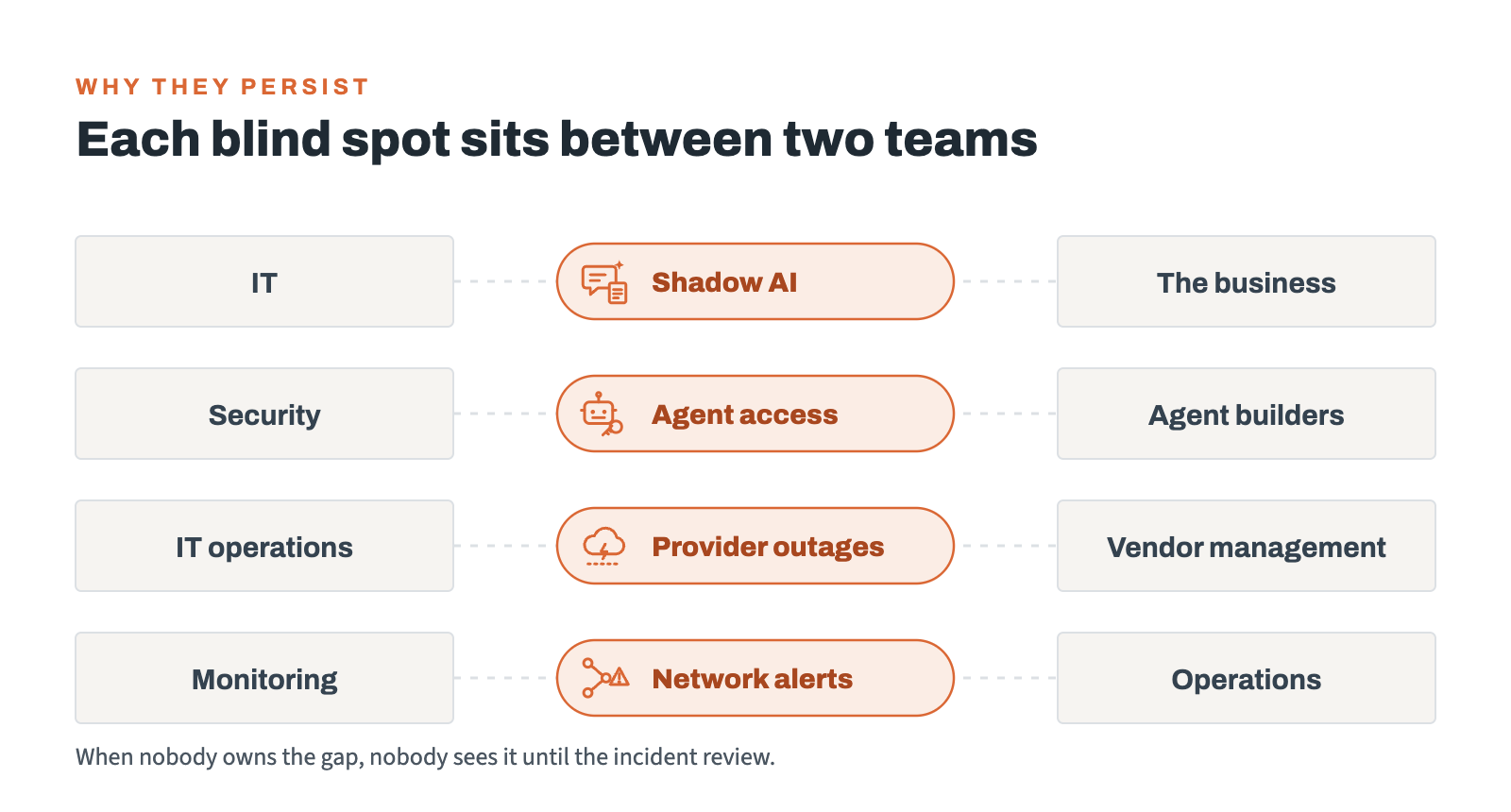
None of these blind spots looks like an emergency. That is exactly why they persist. Each one sits between two teams, so each team can reasonably assume the other has it covered:
When an incident does happen, it often runs through more than one of them at once. An unreviewed key, an unexplained outage and an ignored alert can be three chapters of the same story. Closing the gaps starts with the least glamorous step in security: deciding who owns what.
You don't need a new platform to make progress. A focused month can move all four blind spots from invisible to owned:
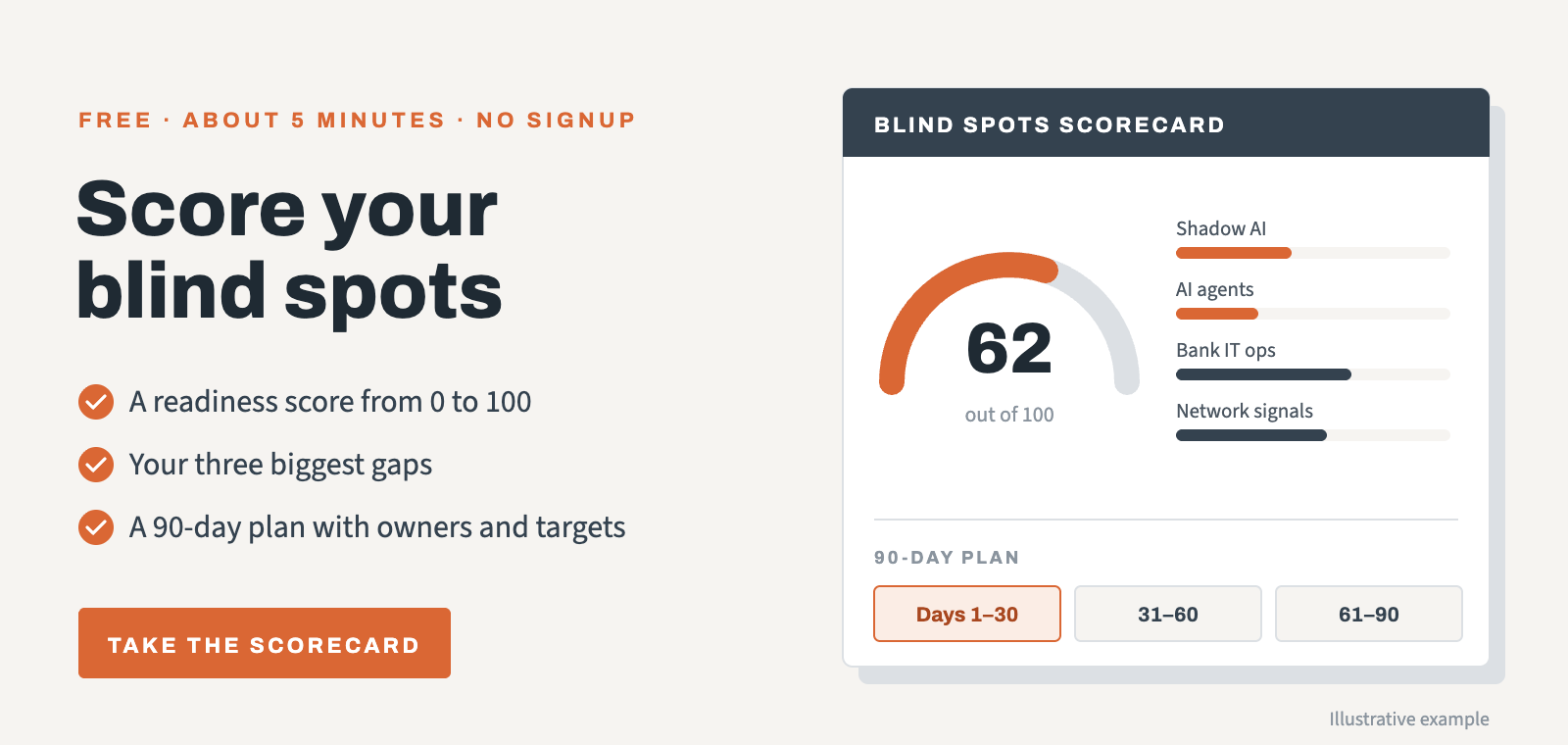
MALA's free Blind Spots Scorecard rates your readiness across all four areas: shadow AI, AI agents, bank IT risk and network warning signals. You get a readiness score, your three biggest gaps, and a 90-day plan with owners, targets and metrics you can take to your board.
It was built by current and former technology executives, it's vendor-neutral, and it needs no signup. Your results appear on screen. If you'd like a second opinion on what you find, a MALA advisor will walk through it with you at no cost.
Take the Blind Spots Scorecard
Shadow AI is the use of AI tools that IT or security hasn't approved, often free chat tools that staff use to summarize, draft or analyze work data. The risk isn't the tool itself; it's that sensitive data leaves your control without anyone knowing.
A chatbot answers questions. An AI agent takes actions, such as updating records, sending messages or calling other systems, using credentials you grant it. That's why agent access needs the same controls as a privileged user.
Regulated organizations remain responsible for services they outsource. Examiners and auditors expect you to understand and manage how critical providers fail, which is hard to show without root-cause reports and an outage history.
Yes. It takes about five minutes, needs no signup, and shows your results on screen.
IT, security and risk leaders, particularly at banks, credit unions and other regulated organizations. The shadow AI, AI agent and network sections apply to most mid-market companies.
Cybersecurity Awareness Month · Video 2 of 4
Don't make it easy for them.
Oct 5: Payment fraud and deepfakes · Oct 12: Blind spots · Oct 19: Compliance deadlines · Oct 26: Cyber insurance renewal
About the author: Eric Anderson is the Founder and President of MALA Technology Advisors. After two decades working with organizations ranging from early-stage startups to Fortune 500 enterprises, he saw the same pattern repeat: significant technology decisions being made without independent, vendor-neutral expertise at the table. He founded MALA to close that gap, and now leads its advisory practice across cybersecurity, cloud, AI infrastructure, and technology procurement.